

By offering up to €84,000 per dwelling to restore vacant and derelict homes on qualifying offshore islands, the Eire government is recognising something other countries still ignore: if you want remote communities to thrive, you have to help them get set up.
This is not just a quirky property story. It is part of a 10-year national policy published in June 2023 to support Ireland’s offshore islands as living communities rather than picturesque relics. The policy is explicitly about population, infrastructure, jobs and long-term viability. In other words, Ireland is treating remote place-making as policy, not nostalgia.
For anyone interested in off-grid or near-off-grid life, that matters. The obstacle is rarely the dream. It is the upfront cost of rescuing a broken shell, moving materials to a difficult site, making the building weather-tight, and then installing the energy, water and communications systems that make remote life workable. Ireland’s refurbishment support does not directly pay for a solar array or a battery bank, but it does something just as important: it lowers the cost of getting the building itself back into use. And the state now allows eligible applicants under the vacant-property scheme to pursue energy-upgrade grants as well, provided the energy-efficiency works are separate from those funded under the refurbishment grant.
The standard national Vacant Property Refurbishment Grant offers up to €50,000, with a derelict top-up of up to €20,000, bringing the mainland total to €70,000. On offshore islands, the support can be 20% higher, which is how the upper limit reaches €60,000 for a vacant property and €84,000 for a derelict one. The government introduced that uplift from 1 July 2023, explicitly acknowledging the extra cost of building on islands.
That may sound like an administrative detail. It is not. Remote living rises or falls on logistics. Ferrying materials, finding trades, stretching project timelines, dealing with weather and distance — these are the hidden taxes on any island refurbishment. So the Irish state is doing something unusually sensible: pricing remoteness into policy, instead of pretending that a home on a far-flung island costs the same to rescue as one in a mainland town.
Derek Trenaman’s off-grid example shows what this could unlock
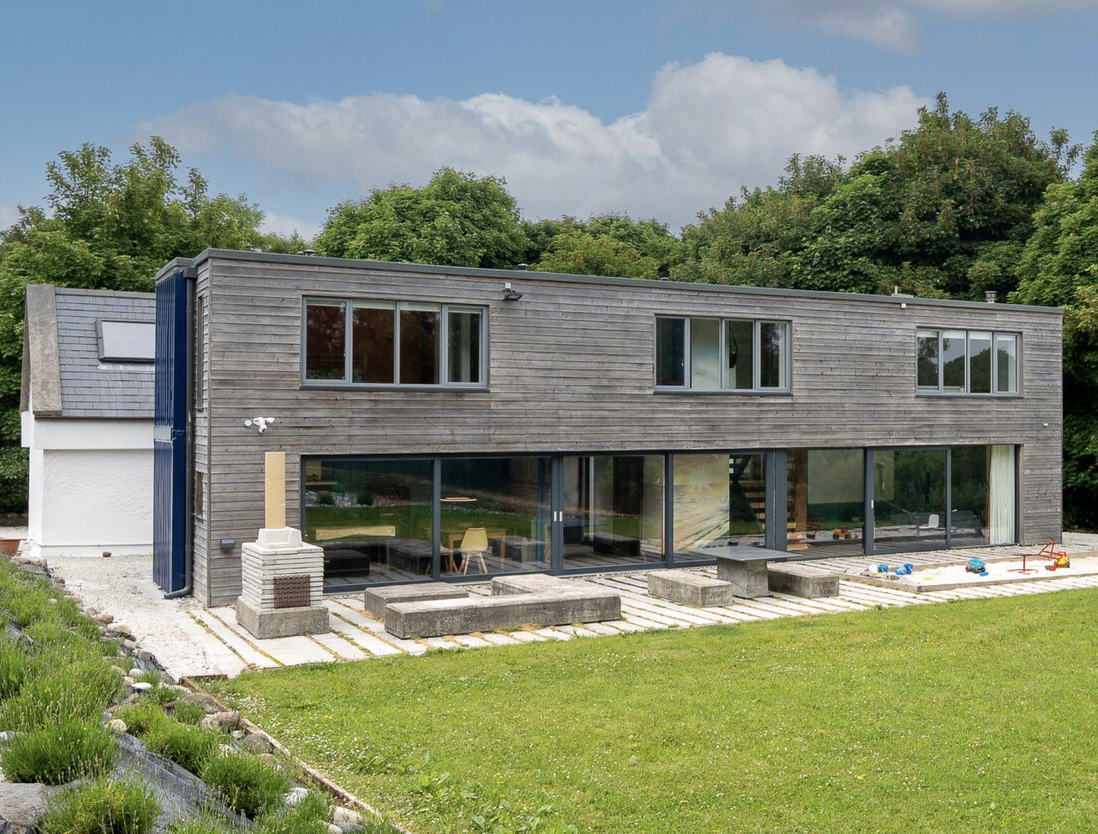
One of the most stirring Irish examples of this kind of thinking is Derek Trenaman’s renovation in Easkey, County Sligo. Trenaman, founder of Ceardean Architects, bought a derelict cottage in 2009 and spent years gradually transforming it. According to The Journal, the building “remained off-grid for a 10 year period” and grew with him “as his family grew.” He described it as a project that he was happy to let “tick along”, doing much of the work himself rather than forcing it into a conventional developer timetable.
That detail matters because it tells you this was not a quick television makeover or a speculative flip. It was a slow-burn act of reclamation. Trenaman told The Journal that the house had been designed from the beginning around a masterplan that included the later addition of four shipping containers. He said the building “evolved slowly over time” and that he wanted to work on it at his own pace.
The original structure, dating from the 1800s, was in poor condition. The whole cottage had to be re-floored, layers of thatch and the old roof removed, and a new slate roof installed simply to secure the building. But by beginning with the old cottage rather than demolishing and starting again, he created a place that could be lived in and enjoyed while it continued to evolve. He also made a point of preserving the character of the original house as much as possible.
As for whether he lives there full-time or uses it as a weekend place, the public record is a little mixed. Ceardean’s own site describes it as an “off-grid holiday home” and an older Ceardean post calls it a “holiday cottage.” But The Journal’s 2025 feature strongly suggests it became a lived-in family home over time, saying the cottage grew with him “as his family grew” and could be “lived in and enjoyed over time.” The safest reading is that it began as a holiday or retreat project and evolved into something more substantial and more fully inhabited.
What Trenaman seems to have said, more than once and in different ways, is revealing. He was not chasing instant perfection. He was pursuing a house that could evolve, remain rooted in the original cottage, and prove that a derelict building on the western edge of Ireland could become a modern, self-reliant place without losing its soul. That is very close to the off-grid argument in its best form: not escape for its own sake, but careful, resilient renewal.
More examples
There are now real, grant-backed refurbishments happening at scale. RTÉ reported in December 2024 that the vacant-home refurbishment scheme was having a “phenomenal” effect in Donegal, with once-derelict properties being brought back into use, while The Irish Times profiled John and Amanda O’Connell, who used vacant-property grants to renovate Cloverhill House outside Ballinamore in County Leitrim. It shows the state is creating a platform that off-grid-minded renovators can build on. Once the shell is funded back into life, the next layer can be insulation, solar, batteries, heat pumps, water systems and local food production. And since SEAI energy grants can sit alongside the refurbishment scheme, the ingredients for much more self-reliant rural and island homes are plainly there.
Why this matters beyond Ireland
For years, off-grid living has been sold as a personal fantasy — brave, eccentric, perhaps worthy, but basically marginal. Ireland is nudging it into a different political category. It is saying, in effect, that remote settlement can be part of a national strategy for demographic renewal and community resilience.
That is the real significance here.
Not every island house will become off-grid. Not every ruin should be saved. Not every grant-backed project will become a model of low-impact living. But once a government starts paying serious money to revive abandoned homes in hard-to-reach places, it opens the door to something bigger: a new generation of people treating remote living not as retreat, but as infrastructure.
Britain should pay attention. So should every country with hollowed-out coastal settlements, declining islands and forgotten rural stock.
Ireland has not solved the problem. But it has grasped a truth that others still dodge: if you want life in remote places, you have to fund the basics.
And once you do that, off-grid living stops looking like a fringe fantasy.
It starts to look like the future.