

The UK energy conversation has a new shiny object: free electricity.
It’s everywhere. It’s buzzy. It’s oddly cheerful, as if we’ve all woken up to discover the energy crisis has been solved by a supplier’s marketing team.
And that’s the point.
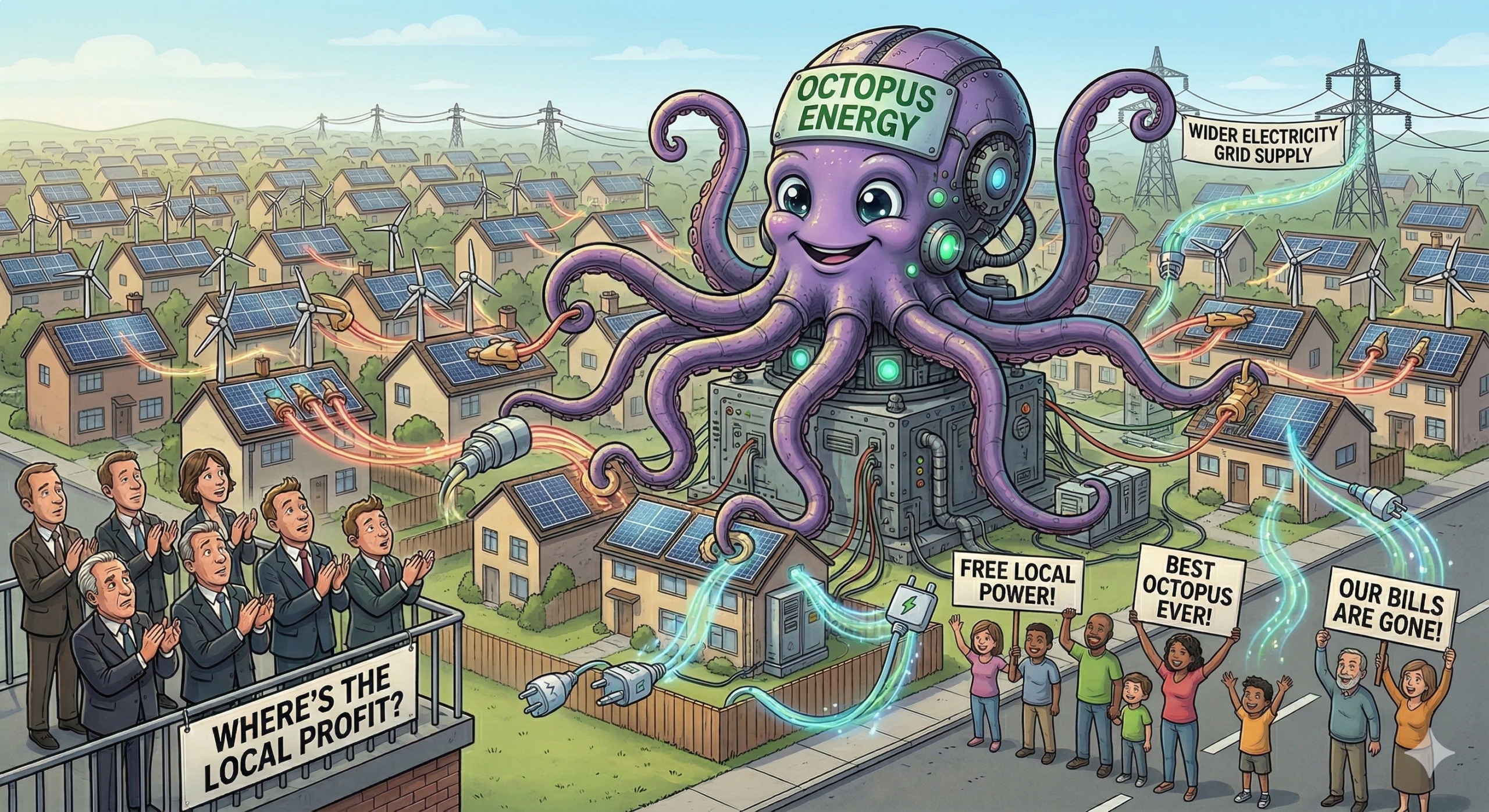
What we’re watching is a marketing arms race. It isn’t about local energy reform. It’s about who gets to own the story of “helping households” at the precise moment the energy system is under strain, the grid is increasingly fragile, and the public is starting to notice.
Octopus is doing it. EDF is doing it. Others will follow.
The problem isn’t that suppliers are running promotions. The problem is that these promotions are being presented as consumer empowerment — when in reality they are a way of keeping the UK locked into a grid-first model that stops communities receiving the full benefits of clean energy.
Octopus, EDF, Eon…
Let’s stop pretending these are different animals.
Octopus has built a big public narrative around “saving sessions” and “free electricity sessions” — moments when there is surplus renewable generation and customers are encouraged to shift their behaviour into those windows. It’s clever, it’s gamified, and it’s designed to flood the media and social feeds with the idea that Octopus is the friendly face of the future.
EDF’s Sunday Saver is the same playbook. EDF literally wraps it in Sunday-morning lifestyle imagery — “kettles boiling, toasters popping and pans bubbling” — and then explains the mechanism: customers can earn up to 16 hours of free electricity on Sundays by shifting usage away from weekday peak hours (4pm–7pm). (EDF press release, 19 Feb 2026.)
This is not a philosophical difference. It’s the same market move:
-
make the public feel like electricity is “free” at certain times
-
turn behaviour change into a “reward”
-
present it as consumer generosity
-
nudge the conversation away from the deeper question: who controls local energy, who profits, and why local power still has to go into the grid first
If you want a single sentence to hang onto when the PR fog descends, it’s this:
It isn’t free electricity — it’s a discount you earn by behaving the way the grid needs.
These offers aren’t a supplier walking into the room and giving households free power out of the goodness of their heart. They’re a structured retail deal that typically depends on:
-
a narrow time window
-
baseline calculations
-
a reward mechanism (often bill credits)
-
and, crucially, system conditions (surplus or peak avoidance)
In plain English: you only get the “free” part if you behave in a way that helps system balancing or takes advantage of surplus that would otherwise be awkward, wasted, or cheap anyway.
That’s not a moral critique. It’s simply what’s happening.
The question is: why is it being framed as a local energy revolution?
Because local energy reform would look very different.
US parallel: “Free weekends” retail theatre
If all this feels familiar, it should.
In parts of the US, especially Texas, “free time” electricity plans have been a retail tactic for years. You get “free nights” or “free weekends” and you shift your laundry, dishwasher, EV charging and high-use activities into those periods. It’s a brilliantly effective way to acquire and keep customers.
Reliant, for example, sells a “Truly Free Weekends” plan with a defined free period and very explicit language about what is and isn’t charged during that time.
This is the same psychology being imported into the UK, except here it’s being wrapped in a much more flattering story: green energy, social responsibility, saving the planet, saving the consumer.
It’s still retail conditioning.
It changes household behaviour. It doesn’t change the structure.
The missing story: “local energy” that isn’t allowed to be local
Here is the bit that almost nobody says out loud:
If local power has to go into the grid first, it stops being local.
Local becomes a marketing adjective attached to a grid-first reality.
Energy is generated near you… routed away through the grid… monetised through supplier systems… and then sold back to you under grid rules, grid charges, supplier margins, and “flexibility” narratives.
That is not “local benefit.” That is grid-scale energy wearing local clothing.
And it’s why you can have endless talk of community energy while the UK still sits in the absurd position where local/community ownership is tiny — around 0.5% — while the US is far higher, around 11% by the commonly cited comparison.
A country doesn’t stay that far behind because it lacks solar panels. It stays behind because the rules and business models block the public from capturing the value.

This isn’t random. This wave is arriving at exactly the moment households are waking up to three uncomfortable truths:
-
The grid isn’t as reliable as we assume
Even in a developed country, people are noticing more outages, more constraints, more talk of “capacity,” and more friction getting things connected. -
Demand is changing fast
Households are being asked to electrify everything — heating, transport, cooking — while enormous electricity users like data centres expand aggressively. In simple terms: households are increasingly competing for power and capacity with machines. -
Resilience is becoming a consumer desire, not a fringe hobby
People used to buy solar to “save the planet” or “cut the bill.” Increasingly they buy solar + batteries because they want something much more basic: electricity that still works when the grid doesn’t.
That shift scares incumbents, because it changes the relationship. It turns the household from “passive customer” into “energy actor.”
And that is why the PR war is about batteries and flexibility right now. It’s about controlling the story of household autonomy before it becomes politically uncontrollable.
What real local energy looks like
Real local energy is not “free electricity sessions.”
Real local energy is a rights-based model that does two simple things:
-
Keeps local electricity local by default
Local generation should serve local demand first. -
Allows people to sell electricity direct to their neighbours
If I generate power on my roof, or in my village scheme, I should be able to sell it locally at a cheaper price than the grid would charge — without being forced through wholesale markets and supplier interfaces that strip out the benefit.
This isn’t about abolishing the grid. The grid still matters. It’s a national asset for balancing, backup, and interconnection.
But it shouldn’t be a compulsory middleman in every local transaction.
Because once everything is forced through the grid, the local advantage is diluted — and the consumer never receives the full benefit.
The punchline
Octopus and EDF are doing excellent marketing. Their campaigns are well designed, emotionally smart, and highly shareable. They take a complex system problem and translate it into a “win” the public can feel.
But don’t confuse that with local energy reform.
It isn’t free electricity — it’s a discount you earn by behaving the way the grid needs.
And the reason it’s being pushed so hard is that it’s safe. It doesn’t threaten the model. It doesn’t give communities rights. It doesn’t move value out of the incumbent stack.
If we actually want a local energy revolution — one that cuts bills, builds resilience, and gives households power that still works when the grid goes down — then we need to stop applauding grid-first PR and start demanding the two rights that matter:
-
the right to keep local electricity local
-
the right to sell electricity direct to your neighbour
That’s the line between local energy that empowers the public… and grid-scale energy posing as local.